[GNU Manual] [No POSIX requirement] [Linux man] [FreeBSD man]
Summary
mktemp - make directories
Lines of code: 351
Principal syscall: mkdir(), open(), stat()
Support syscalls: write() via puts()
Options: 13 (6 short, 7 long)
Added to Coreutils in October 2007 [First version]
Number of revisions: 49 [Code Evolution]
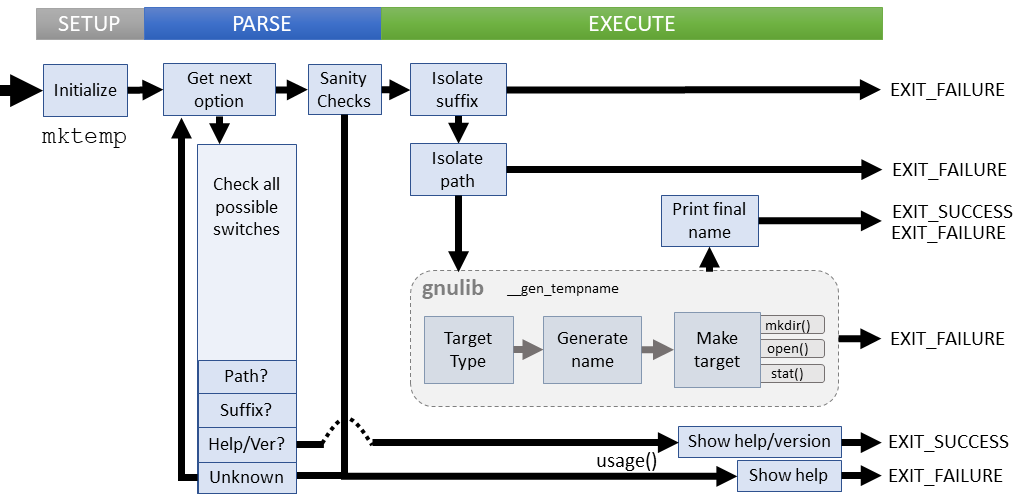
The core work behind mktemp happens within gnulib. The utility allocates buffers and parses the target name to provide appropriate counts before passing off file creation responsibility
Helpers:count_consecutive_X_s()- Returns asize_tcount of Xsmaybe_close_stdout()- Closes STDOUT based on global flag settingmkdtemp_len()- Wrapper forgen_tempname()to create a temp directorymkstemp_len()- Wrapper forgen_tempname()to create a temp file
die()- Exit with mandatory non-zero error and message to stderrerror()- Outputs error message to standard error with possible process terminationfile_name_concat()- Concatenates two files names (in gnulib)gen_tempname_len()- Generates a hard-to-predict temp file name (in gnulib)last_component()- Returns the final component of an input path (in gnulib)
Setup
mktemp defines one global flag, stdout_closed to track if STDOUT has been closed during execution. It is checked prior to exit to avoid a double close.
mktemp initializes a list of local variables in main(), including:
c- The first letter of the next option to processcreate_directory- Flag if the target is a directory*dest_dir- Pointer to the destination directory, user provided or default*dest_dir_arg- Pointer to the provided directory string*dest_name- The name of the final target createddeprecated_t_option- Flag set if the name is a single file name (-t)dry_run- Flag to test the generated name (-u)n_args- Number of arguments (beyond options)*template- The user provided template string, defaulttmp.XXXXXXXXXXstatus- The final return status of the utility*suffix- Pointer to the user provided suffix stringsuffix_len- The length of the suffixsuppress_file_err- Flag for quiet modeuse_dest_dir- Flag to use the user provided directory (-p or -t)x_count- The consecutive X count
Parsing
Parsing mktemp considers five questions:
- Are we creating a file or directory?
- Is this a test run to see resulting output?
- Is there a desired file suffix, such as an extension?
- Should the target file follow a specified template
- Should error messages be suppressed
Parsing failures
These failure cases are explicitly checked:
- Adding more than one template argument
- Specifying suffix with a template that doesn't end in X
- Embedding a directory with a suffix
- Including a directory within a template
- Using an absolute-form template
- Less than 3 Xs provided in the template
- Unknown options used
Failures result in a short error message followed by the usage instructions.
Execution
The mktemp utility computes the boundaries of the temporary name before passing them to the gnulib. The logic is this:
- Get the length of the template.
- Get the length of the suffix, which may be 1 if default.
- Allocate space for the name.
- Count the number of Xs in the template
- Get the leading path length, if any.
- Concatenate the path, unprocessed template, and suffix components
- Pass the incomplete template to gnulib via wrappers
- Files:
mkstemp_len()Directories:mkdtemp_len() - Output the random temp file name created
Failure cases:
- Unable to create target file or directory
- Unable to print name of the successfully created target
- The target is removed if it cannot be reported properly
Failures at this stage output an error message to STDERR unless quiet mode was enabled