[GNU Manual] [POSIX requirement] [Linux man] [FreeBSD man]
Summary
df - report file system disk space usage
Lines of code: 1819
Principal syscall: stat(), statvfs()
Support syscalls: fstatat()
Options: 30 (14 short, 16 long)
Descended from df introduced in Version 1 UNIX (1971)
Added to Fileutils in October 1992 [First version]
Number of revisions: 298
Two general strategies are to ask the filesystem for accounting metadata or check every file and estimate. The df utility uses the former strategy via sysfs()/sysvfs(). Check out the du utility for the other strategy
add_excluded_fs_type()- Removes a filesystem from processingadd_fs_type()- Adds a file system to be processedadd_uint_with_neg_flag()- Handles signs for uint types as a distinct flagadd_to_grand_total()- Fully summarizes usagealloc_field()- Allocates space for a fieldalloc_table_row()- Allocates a row for the output tabledecode_output_arg()- Parse the output arguments for the eventual displaydevlist_compare()- Comparison function for devicesdevlist_for_dev()- Locate a device within the device tabledevlist_free()- Free the devlice listdevlist_hash()- Index function for the device listdf_readable()- Human-readable display with distinct negative flagexcluded_fstype()- Checks if a filesystem type is excludedfilter_mount_list()- Removes duplicates, ensuring distinct mount list entriesget_all_entries()- Constructs a list of all distinct mount entriesget_dev()- Creates an output listing for a given deviceget_disk()- Display usage for a single mount pointget_entry()- Verifies device request and preparesstat()get_field_list()- Prepares the table columnsget_field_values()- Gathers block/inode valuesget_header()- Builds the appropriate headerget_point()-stat()the device at the given mount pointhas_uuid_suffix()- True if the input is a UUIDhide_problematic_chars()- Convert control characters to '?'last_device_for_mount()- Returns a string for the last device mountedme_for_dev()- Finds a device in the mount entry listprint_table()- Final output for dfselected_fstype()- Returns true if the input is a displayed fs type
free_mount_entry()- Removes a mount entryget_fs_usage()- The workhorse function to get fs data for many systems (from gnulib)human_readable()- Formats numeric data with meaningful suffixesread_file_system_list()- Parses mounted filesystems at /proc/self/mountinfo
Setup
df defines a few global structs and variables prior to execution:
struct devlistis a single-linked list of devices (number/mount point)struct fs_type_listis a list of filesystem typesstruct field_values_tholds the possible values of all fieldsstruct field_data_tholds the attributes for a single field
The global variables are dedicated to the option flags and the data table to display, including:
show_all_fs- Flag for all files systems (-a)show_local_fs- Flag for only checking local filesystems (-l)show_listed_fs- Flag to display only given filesystems (cli arguments)file_systems_processed- Flag set if any file system was processed*fs_select_list- The list of file systems explicitly requested*fs_exclude_list- The list of file systems explicitly ignoredprint_type- Flag to show the file system type (-T)print_grand_total- Flag to show the usage grand total (--total)field_data[]- The header for each column**columns- The data for each column***table- The values in each cell (*table -> *column -> *cell)
Also, several enum types are defined to facility options, which include the display mode, the field basis (block/inode/text), the actual field types, etc.
main() initializes all of the above to default values (or NULL pointers). Two more local variables are defined:
*msg_mut_excl- Error message for mutually exclusive optionsposix_format- Forces the posix output format (-p)
Parsing kicks off with the short options passed as a string literal:
"aB:iF:hHklmPTt:vx:"
Parsing
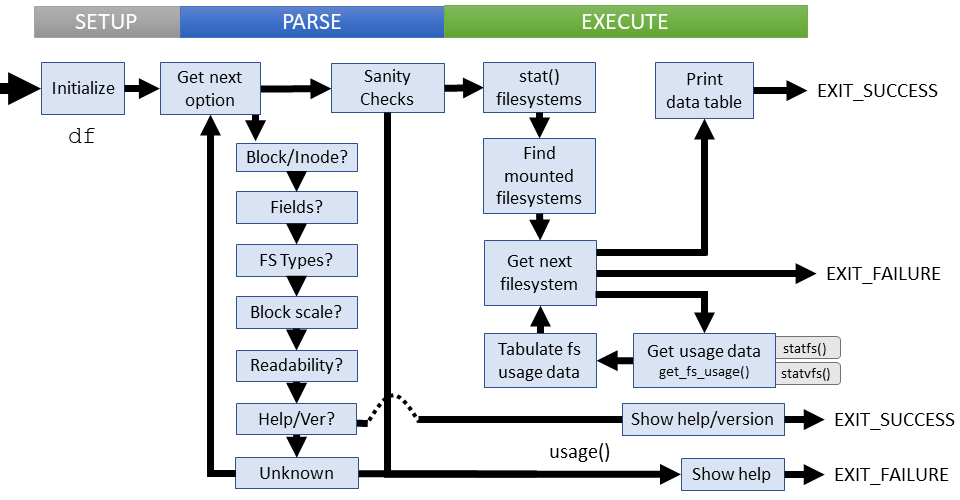
Parsing df asks a few questions from the user:
- What file systems and types are we interested in?
- What information (fields) of data do we want?
- What units do we want the answer in? (block/inodes?)
- Any special considerations for the display? (POSIX style?)
Parsing failures
Parsing may fail in several ways:
- A filesystem type is both selected and excluded
- Including the --output option with any of -i, -T, or -P
- Using output fields with inode, portability, and print-type options
User specified parsing failures result in a short error message followed by the usage instructions. Access related parsing errors die with an error message.
Execution
Executing the df utility follows this path:
stat()any of the explicitly checked file systems- Build the list of currently mounted devices
- Construct the output table header and column structures
- Go through each mounted device and get file system data
- Construct the table entry
- Print the output table
Failure cases:
- No file systems are processed (nothing mounted or target not available)
- Unable to access file systems
All failures at this stage output an error message to STDERR and return without displaying usage help